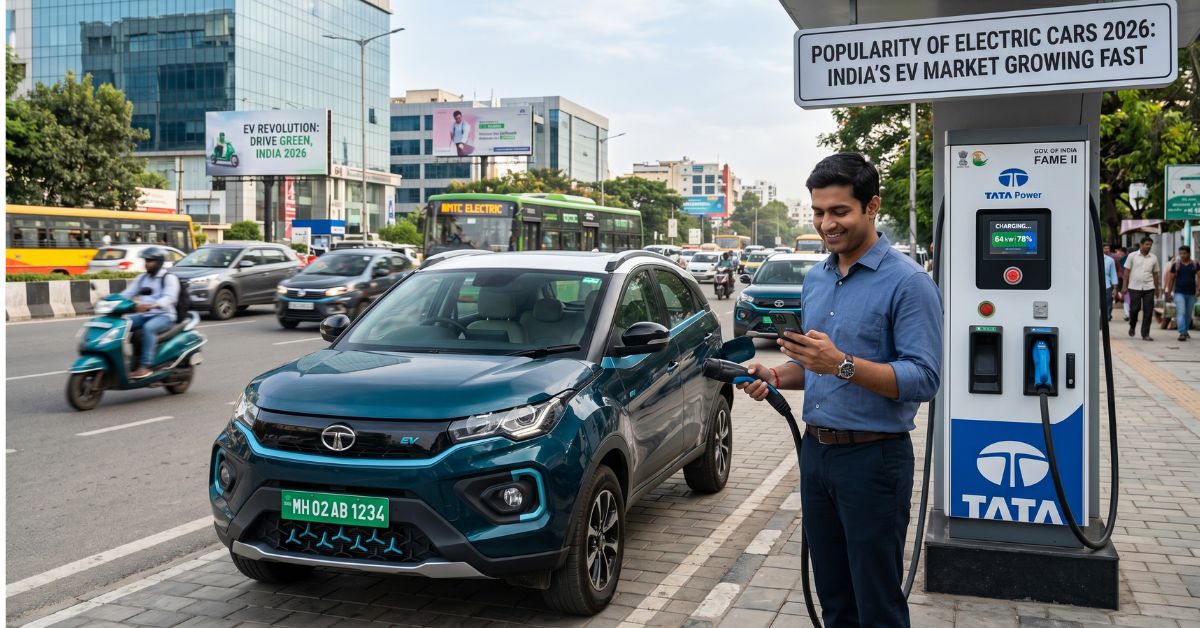
Popularity of Electric Cars: 2026 is no longer seen as a rare choice in India. In 2026, more buyers are checking electric cars before buying a petrol or diesel car. Rising fuel costs, better charging access, new EV models, and government support are making electric cars more popular in cities as well as smaller markets.
This article explains what is driving the popularity of electric cars in 2026, what the latest numbers show, why it matters for India, and what buyers should watch next.
What Happened?
The popularity of electric cars in 2026 in India has grown strongly in 2026. Recent retail data shows that electric passenger vehicles are taking a bigger share of the Indian car market. This is important because electric cars were earlier seen mainly as a city-only option, but now they are becoming part of the normal car-buying discussion.
The retail share of electric cars in the passenger vehicle segment was 6.63% in May 2026, higher than 4.51% in May 2025. Crossed 11% for the first time in overall EV penetration across vehicle categories. This indicates that buyers are looking beyond electric two and three wheelers to electric cars as well.
There are many reasons for the change. Buyers are still hugely concerned about petrol and diesel running costs. Meanwhile, many car companies are rolling out more electric choices with longer range, better features and easier financing. Charging infrastructure is increasing too but it needs to grow faster.
Key Details About Electric Car Popularity in 2026
Electric car demand is rising because Indian buyers are comparing the total cost of ownership, not just the showroom price. An electric car may cost more at the time of purchase, but lower running costs can make it attractive for daily users.
For people who drive within the city, EVs are becoming more practical. Many owners can charge at home or in office parking areas. This reduces their dependence on public charging stations for daily use.
The market is also becoming more competitive. Earlier, only a few companies were serious about electric cars in India. Now more brands are launching EVs or preparing EV models. This gives buyers more choices in terms of size, price, range, and design.
Another big reason is awareness. More buyers now understand terms like battery range, fast charging, battery warranty, and running cost. This makes them more confident about considering an electric car.
Background: How India Reached This Point
India’s EV journey started with stronger adoption in two-wheelers and three-wheelers. Electric scooters and e-rickshaws became popular before electric cars because they were cheaper and easier to use for short-distance travel.
Electric cars took more time to grow because of higher prices, limited charging points, and range anxiety. Many buyers were unsure whether an EV could handle daily family use, highway travel, and long-term battery health.
That changes in 2026. Battery tech has gotten better, carmakers are offering better warranties and charging networks are growing in cities and on highways. Government schemes have also helped instil confidence in electric mobility.
The PM E-DRIVE scheme is one of the major government steps to support electric mobility. It focuses on EV adoption and charging infrastructure. While direct support for private electric cars is limited compared with some other EV categories, the overall ecosystem support helps the market.
Why Electric Cars Are Becoming Popular in India
Lower Running Cost
The biggest reason is running cost. A petrol or diesel car can become expensive for daily travel, especially for office users and families who drive often. Electric cars can reduce daily fuel spending because electricity is usually cheaper than petrol or diesel for the same distance.
This is why many urban buyers are calculating monthly savings before choosing a car. For a person who drives regularly, the savings over a few years can become meaningful.
More EV Models
More electric car models are entering the Indian market. Buyers now have options across compact SUVs, hatchbacks, and premium electric cars. This helps EVs move from a niche product to a mainstream option.
When buyers see more models on roads, trust also improves. A stronger service network and more spare part availability can further support this trend.
Better Charging Network
Charging is still one of the biggest concerns, but the network is improving. Public charging stations are being installed at fuel pumps, malls, offices, residential societies, and highways.
The growth is not equal in every state, but the direction is clear. More charging points can reduce range anxiety and make EVs more useful for intercity trips.
Rising Fuel Prices and Pollution Concerns
Fuel-price pressure is another strong reason behind the shift. When petrol and diesel prices remain high, buyers start looking for alternatives. EVs also attract people who want cleaner transport and lower tailpipe emissions in cities.
India’s big cities continue to face air pollution problems. Electric cars alone cannot solve pollution, but they can reduce direct vehicle emissions on roads.
Government Push and Policy Support
The government has been pushing electric mobility through schemes, charging infrastructure support and policy signals. PM E-DRIVE scheme has a big outlay, aims to help EV adoption and charging infrastructure.
State governments also have an important role to play. There are benefits like road tax benefits, registration benefits or charging support in some states. The benefits can change from time to time so buyers should check the latest state policy before booking an EV.
Impact in India
The rising popularity of electric cars could have an impact on many sectors in India. Automakers will need to invest more in EV platforms, batteries, software and service training. Sales teams will have to be trained to explain the range, charging and battery warranty clearly to dealers.
For consumers, the impact can be positive if competition increases. More competition can bring better features, improved battery range, and more affordable EVs over time.
For the power sector, EV growth means higher electricity demand from homes, offices, and public chargers. This creates new opportunities for charging companies, power distribution firms, and renewable energy players.
For cities, EV adoption can reduce local tailpipe emissions. But India also needs cleaner electricity generation, proper battery recycling, and safe charging standards to get the full environmental benefit.
What It Means for Indian Car Buyers
For buyers, 2026 is an important year to study electric cars seriously. EVs may be a good choice for people who drive daily within a fixed route and have access to home or office charging.
But don’t buy an EV just because it’s trendy. They should consider real world range, charging time, service support nearby, battery warranty, resale value. If you’re a buyer who regularly drives long distances, check out fast charging options along your usual routes, too.
The best approach is to compare the total cost over five to seven years. This includes purchase price, charging cost, insurance, service cost, battery warranty, and expected resale value.
Challenges Still Remain
Electric cars are becoming popular, but some challenges are still present. The first challenge is price. Many EVs still cost more than similar petrol cars. This makes them difficult for budget buyers.
The other issue is access to charging. Charging at home isn’t always easy, especially for those living in rented flats or older apartments. Public chargers are increasing but not equally across the board.
The third challenge is battery confidence. Many buyers still worry about battery life, replacement cost, and long-term performance. Clear warranty terms and transparent service support are needed to solve this.
The fourth challenge is highway charging. City use is becoming easier, but long trips still require planning in many regions. More fast chargers on national and state highways will be important for the next stage of EV growth.
Why It Matters for India
The popularity of electric cars matters because India is one of the world’s largest automobile markets. If EV adoption grows steadily, it can reduce oil import pressure, support cleaner mobility, and create new jobs in battery, charging, software, and component manufacturing.
It also gives Indian carmakers a chance to become stronger in future mobility. Companies that invest early in EV technology may get a long-term advantage.
For the government, higher EV adoption supports clean energy and net-zero goals. But the growth must be balanced with safe batteries, charging standards, recycling systems, and a reliable electricity supply.
Important Official Updates
The PM E-DRIVE scheme remains one of the key official policy updates for India’s EV ecosystem. It was approved with an outlay of ₹10,900 crore to promote electric mobility and build charging infrastructure.
The Ministry of Heavy Industries has also stated that setting up EV public charging stations is an unlicensed activity. This means private companies can participate in building charging infrastructure, as long as they follow the required technical and safety rules.
The government has allocated ₹2,000 crore under PM E-DRIVE for EV public charging stations across India. This is important because charging infrastructure will decide how fast electric cars become practical for more people.
What Happens Next?
The next phase of electric car growth in India will depend on three things: price, charging, and trust. If EV prices come closer to petrol cars, adoption can rise faster. If charging points become more reliable, buyers will feel more confident. If battery warranties and service networks improve, long-term trust will grow.
In the coming months, more carmakers are expected to focus on electric SUVs and mass-market EVs. Buyers can also expect more competition in range, features, and charging speed.
Read More: Cheapest Car in India 2026
Electric cars may not replace petrol and diesel cars immediately, but their role in India’s car market is clearly growing. In 2026, EVs are moving from “future technology” to a real buying option for many Indian families.
FAQs (Popularity of Electric Cars 2026)
Why are electric cars becoming popular in India in 2026?
Electric cars are becoming popular because of lower running costs, rising fuel prices, more EV models, better charging infrastructure, and growing awareness among buyers.
Are electric cars cheaper to run than petrol cars?
Yes, electric cars usually have lower running costs than petrol cars. However, the total benefit depends on electricity cost, daily driving distance, purchase price, and charging access.
Is charging infrastructure good enough in India?
Charging infrastructure is improving, but it is not equal everywhere. Big cities and some highways have better access, while smaller towns still need more reliable public chargers.
Should I buy an electric car in 2026?
An electric car can be a good choice if you drive regularly, have home or office charging access, and mostly travel within the city or planned routes. Long-distance users should check highway charging before buying.
What is the biggest problem with electric cars in India?
The biggest problems are higher upfront prices, limited charging access in some areas, and buyer concerns about battery life and resale value.
Will electric cars become more common in India?
Yes, electric cars are likely to become more common as prices reduce, more models launch, charging improves, and buyers gain confidence in battery technology.