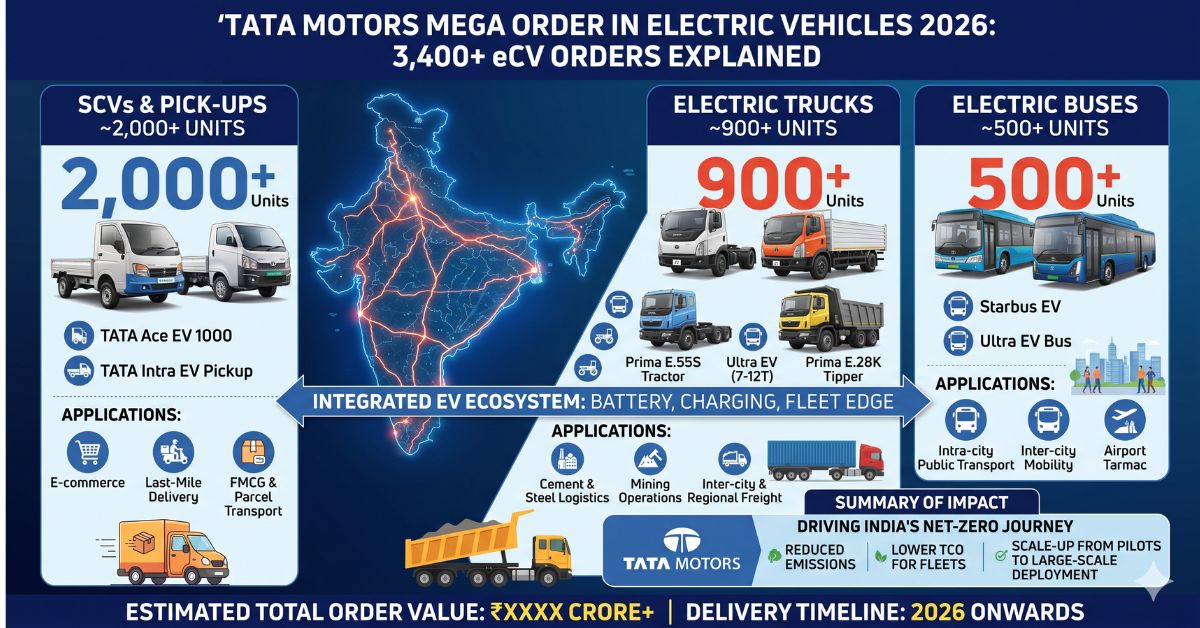
Tata Motors’ Mega Order in Electric Vehicles 2026 has become a major talking point in India’s automobile and business sector. The company has secured orders for more than 3,400 electric commercial vehicles, showing that EV adoption is now moving beyond private cars and into daily business use.
This is important since commercial vehicles work for long hours, travel high daily distances, and have a direct impact on logistics, public transport, delivery businesses, and city pollution. The latest order indicates that Indian businesses and transport operators are now looking at electric vehicles as a serious working solution, not just a future idea.
What about TATA Motors’ mega order in electric vehicles for 2026?
TATA Motors’ Mega Order in Electric Vehicles 2026 has secured orders for over 3,400 electric commercial vehicles across different business and passenger mobility segments. These orders include electric small commercial vehicles, electric pick-ups, electric trucks, and electric buses.
Available reports suggest the order mix includes some 2,000 small commercial vehicles and pickups, about 900 trucks, and nearly 500 buses. These vehicles are intended to address the diverse needs of e-commerce delivery, logistics, FMCG distribution, cement, steel, mining, tarmac, and public passenger transport.
This makes the development important for both the auto industry and the clean mobility sector. It shows that electric commercial vehicles are slowly shifting from trial projects to real business operations.
Key Details of Tata Motors EV Mega Order
The order is not limited to one type of vehicle or one business segment. It covers multiple commercial use cases. This is one of the biggest reasons why the news is being seen as a strong signal for India’s EV market.
The small electric commercial vehicles and pickups are useful for city deliveries, local goods movement, and e-commerce businesses. Electric trucks can meet higher transport needs in sectors such as cement, steel, mining, and logistics. Electric buses can help in the passenger flow of cities, institutions, and transport operators.
The total order size of more than 3,400 units shows that fleet operators are becoming more confident about EVs. Earlier, many businesses were waiting to see whether electric commercial vehicles could handle Indian road conditions, charging needs, and operating costs. This order suggests that confidence is growing.
Why This Order Matters
This order matters because commercial vehicles are a major part of India’s transport economy. Trucks, pick-ups, vans, and buses are used every day for goods and people movement. If this segment starts moving toward electric mobility, the impact can be much bigger than only electric cars.
For businesses, electric commercial vehicles can reduce running costs over time, especially in fixed-route operations where charging can be planned. For cities, electric buses and delivery vehicles can help reduce tailpipe emissions. For the auto industry, it creates demand for batteries, charging systems, service networks, and EV-ready supply chains.
This also gives Tata Motors a stronger position in India’s commercial EV market. The company already has experience in electric buses and passenger EVs. With this latest order, its commercial EV portfolio gets more visibility.
Background: Tata Motors and India’s EV Push
Tata Motors has been one of the most visible EV players in India. In passenger EVs, the company has built a strong presence through models such as Tiago.ev, Punch.ev, Nexon.ev, Curvv.ev, and Harrier.ev. In commercial mobility, the company has worked on electric buses, small commercial EVs, and other zero-emission mobility solutions.
India’s EV market is also changing. Earlier, EV conversations were mostly about two-wheelers and personal cars. Now, the focus is also moving toward buses, last-mile delivery vehicles, and trucks. This is because fleet vehicles are used more frequently and can deliver better savings if the charging and route planning are managed well.
Government policy, fuel cost concerns, corporate sustainability goals, and the need to reduce pollution are also pushing companies toward electric mobility. However, EV adoption still depends on charging infrastructure, vehicle price, battery performance, service support, and total cost of ownership.
Impact on India’s Logistics and Delivery Sector
The biggest impact of this order may be seen in logistics and delivery services. India’s e-commerce, grocery delivery, and local goods movement sectors are growing fast. These businesses need vehicles that can run daily with lower operating costs.
Small electric commercial vehicles and pickups can work well for fixed daily routes inside cities. If a business knows its delivery area and daily distance, it can plan charging more easily. This makes electric commercial vehicles more practical for last-mile delivery.
The order also shows that EVs are not only for premium buyers. They are entering core business operations where cost, uptime, and reliability matter more than style or luxury.
Impact on Public Transport and Buses
The inclusion of electric buses in the order is also important. Electric buses can help cities reduce diesel pollution and improve the public transport experience. They are quieter, cleaner, and better suited for urban routes if charging and maintenance systems are properly planned.
Tata Motors has already supplied electric buses in different Indian cities. The company’s experience in this segment gives it an advantage as more public and private transport operators look for cleaner buses.
However, electric buses require strong charging infrastructure, trained maintenance teams, and proper route planning. Without these, large-scale bus electrification can face delays.
Impact on Tata Motors Share and Investor Sentiment
After the order news, Tata Motors shares were in focus in the stock market. Investors usually react positively when a large company receives strong orders, especially in a growth area like electric mobility.
However, readers should understand that stock price movement depends on many factors. These include market conditions, delivery execution, margins, raw material costs, competition, and overall auto demand.
The EV order is a positive business update, but it should not be seen as direct investment advice. Investors should check official filings, quarterly results, and expert financial guidance before taking any decision.
Important Official Updates
There are a few important updates around Tata Motors and its EV ecosystem.
Tata Motors has been expanding its commercial vehicle and passenger EV focus. The company has also worked on charging infrastructure plans through Tata.ev initiatives. Charging remains one of the biggest needs for EV growth in India.
In the commercial vehicle segment, Tata Motors has also won large bus-related orders from state transport undertakings in 2026. This shows that the company is active in mass mobility and public transport solutions.
At the same time, Tata Motors has announced price increases for commercial vehicles from July 2026 because of rising input costs. This is important because EV adoption can be affected by vehicle pricing, battery costs, and operating economics.
Why It Matters for India
This order matters for India because it supports three major goals: cleaner transport, lower business running costs, and stronger domestic EV manufacturing.
India’s cities are facing traffic and pollution problems. Commercial vehicles are a regular part of city movement, especially in logistics and passenger transport. If more of these vehicles become electric, cities can see long-term benefits in air quality.
For businesses, electric vehicles can reduce fuel cost pressure. Diesel and petrol prices have always been a concern for transport operators. EVs can offer predictable running costs if charging access is available.
For the auto industry, more EV orders mean more demand for local manufacturing, charging networks, battery systems, software, telematics, and service support. This can create more business opportunities across the EV ecosystem.
What Is Still Unclear?
Some details are still not fully clear. The total value of the order has not been clearly disclosed in available reports. The exact names of all customers have also not been fully listed. The complete delivery schedule is also not clearly available.
This is why the news should be reported carefully. The confirmed point is that Tata Motors has secured orders for over 3,400 electric commercial vehicles. Any claim about exact order value or exact delivery date should be made only after official confirmation.
What Happens Next?
The next important thing to watch is delivery and execution. Large EV orders are only useful if vehicles are delivered on time and perform well in real-world conditions.
Fleet operators will look at range, charging time, uptime, service support, battery life, and overall operating cost. If these vehicles perform well, more businesses may place similar orders in the future.
Another key area to watch is charging infrastructure. Commercial EVs need reliable charging points, especially for vehicles that run daily. Companies may also need depot charging, fast charging, and route-based charging plans.
Tata Motors may also continue expanding its electric commercial vehicle portfolio in 2026 and beyond, depending on customer demand and market response.
Final Verdict
A massive order for electric vehicles in 2026 from Tata Motors is a significant development for the Indian EV market. The order for over 3,400 electric commercial vehicles is proof of companies and transport operators getting serious about electric mobility.
Read More: Popularity of Electric Cars 2026
This is not just about one company getting a large order. It is also about India’s commercial transport sector slowly moving toward cleaner and more efficient options.
The biggest impact will depend on how quickly the vehicles are delivered, how well they perform, and how fast charging infrastructure improves. If the rollout succeeds, it can encourage more Indian businesses to shift from diesel-based fleets to electric commercial vehicles.
FAQs (TATA Motors Mega Order in Electric Vehicles 2026)
What is the Tata Motors Mega Order in Electric Vehicles 2026?
It refers to Tata Motors securing orders for more than 3,400 electric commercial vehicles across different segments such as small commercial vehicles, pickups, trucks, and buses.
How many electric vehicles are included in the order?
The order includes over 3,400 electric commercial vehicles. Reports say this includes around 2,000 small commercial vehicles and pick-ups, about 900 trucks, and nearly 500 buses.
Is this order for passenger cars?
No. This order is mainly for electric commercial vehicles. It includes vehicles used for logistics, freight, business operations, and passenger mobility.
Why is this order important for India?
It is important because it shows growing adoption of electric vehicles in commercial transport. This can support cleaner cities, lower operating costs for businesses, and growth in India’s EV ecosystem.
Has Tata Motors disclosed the total value of this order?
The total order value has not been clearly disclosed in available reports. Readers should wait for official company updates for exact financial details.
Will this affect Tata Motors’ share price?
The order can improve market sentiment, but share prices depend on many factors. Investors should not take decisions based only on one news update.