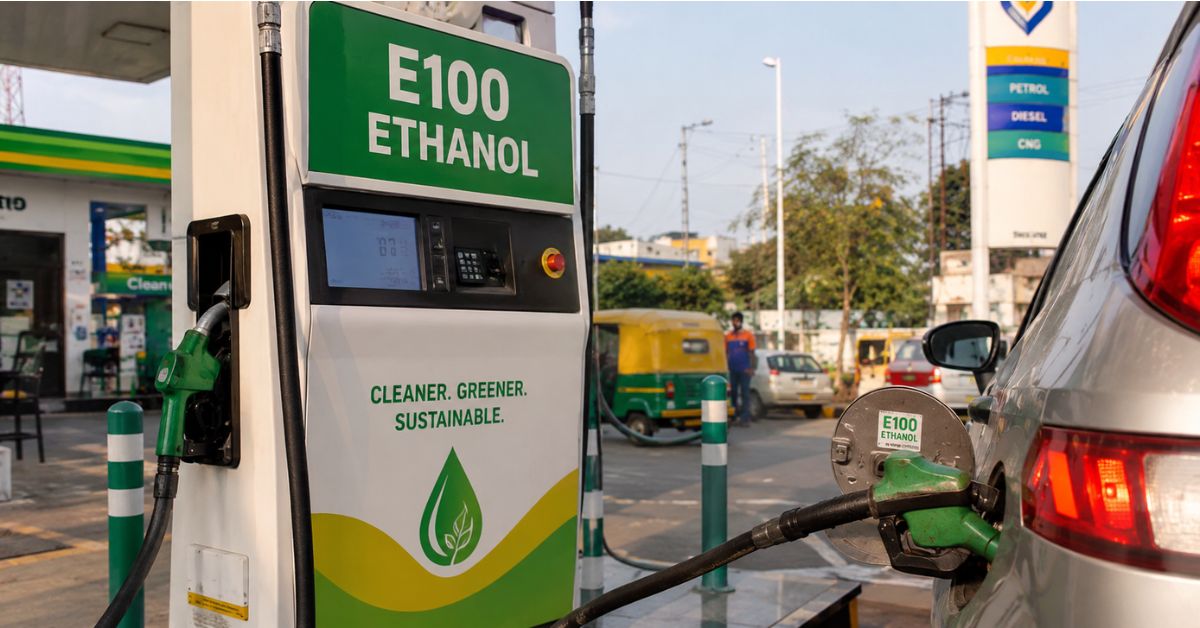
India’s fuel market is moving into a new phase. After the nationwide push for E100 Ethanol Fuel Government Decision 2026 petrol, the government is now moving towards higher ethanol fuels such as E85 and E100. This has created strong interest among vehicle owners, farmers, fuel companies, and automakers.
The latest discussion is the 2026 decision by the government on E100 ethanol fuel. Reports said Union Road Transport and Highways Minister Nitin Gadkari has paved the way for 100% ethanol powered vehicles. At the same time, the government has already begun the E85 rollout at selected fuel outlets.
The question for the average driver is simply can current petrol cars run on E100? No, unless the vehicle is designed and certified for that. E100 is not a normal petrol replacement for old vehicles. It’s mainly intended for flex-fuel vehicles, which can run on high ethanol blends.
What Happened E100 Ethanol Fuel Government Decision 2026 ?
India has moved a big step closer to high-ethanol mobility by 2026. The government had earlier suggested changes in vehicle rules to add higher ethanol fuels such as E-85 and E-100. These changes are important because vehicle manufacturers need a legal and testing framework before they can sell vehicles that are fuelled by such fuels.
Government Decision 2026 E100’ for the rollout of the ethanol fuel has already started at selected retail outlets of public sector oil companies. The plan is to gradually introduce the availability of ethanol fuel stations. In other words, India is not going to make all vehicles run on E100 overnight. Instead, the country is slowly building a fuel and vehicle ecosystem.
The latest reported update is that Nitin Gadkari has signed the file to legally authorize E100 fuel use for vehicles. This is being seen as a big signal for companies like Maruti Suzuki, Toyota, Hyundai, MG, and Hero MotoCorp, which are working on flex-fuel vehicles.
What Is E100 Ethanol Fuel Government Decision 2026?
E100 means ethanol-based fuel with almost 100% ethanol content. Ethanol is an alcohol-based fuel that can be produced from crops and biomass such as sugarcane, maize, damaged food grains, and agricultural waste.
E100 is different from normal petrol and also different from E20. E20 petrol contains 20% ethanol and 80% petrol. E85 contains around 80% to 85% ethanol, and the remaining portion is petrol. E100 is close to pure ethanol.
This is why E100 cannot be used in all vehicles. A normal petrol engine may not be suitable for such a high ethanol blend. Vehicles need special fuel-system parts, engine calibration, and software to handle higher ethanol content safely.
Why Is the Government Pushing Ethanol Fuel?
The government’s main reason is to reduce India’s dependence on imported crude oil. India imports a large part of its oil requirement, and this affects the country’s foreign exchange spending. Ethanol can be produced inside India, so it supports energy security.
The second reason is support for farmers. If ethanol demand rises, crops and agricultural by-products can get another market. The government has often presented farmers as “Urjadata” along with “Annadata,” meaning farmers can become energy providers as well as food providers.
The third reason is pollution reduction. Ethanol is considered a cleaner alternative compared with fossil fuel in many cases. The government has also linked ethanol blending with India’s long-term climate and energy goals.
Key Details of the 2026 Ethanol Fuel Push
The government has moved beyond only E20 and is now building the next stage of ethanol fuel use. E85 has started at limited fuel outlets, and the network is expected to grow in phases.
E85 is meant for flex-fuel vehicles. These vehicles can run on different ethanol-petrol blends, depending on availability. This flexibility is important because India does not yet have E85 or E100 pumps everywhere.
The government has also given tax support for higher ethanol blends. Petrol containing 22% to 30% ethanol has been exempted from excise duty. This can encourage oil companies to move towards higher ethanol blending.
However, this does not mean E100 will become common immediately. Fuel availability, vehicle compatibility, testing standards, customer awareness, and service support will decide the real speed of adoption.
What It Means for Car and Bike Owners
For existing vehicle owners, the most important point is compatibility. If your car or bike is made only for regular petrol or E20, you should not use E85 or E100 unless the vehicle manufacturer clearly allows it.
High ethanol blends need compatible fuel lines, rubber parts, sensors, and engine tuning. Using the wrong fuel may affect mileage, performance, or long-term reliability.
For new vehicle buyers, flex-fuel vehicles may become an option in the coming years. Such vehicles can run on gasoline as well as high ethanol blends. But buyers should check three things before purchase: fuel availability in their city, official vehicle compatibility, and warranty terms.
Impact on India’s Auto Industry
The E100 decision can open a new business direction for Indian auto companies. Maruti Suzuki has already shown interest in flex-fuel cars, and Hero MotoCorp has also worked on ethanol-compatible motorcycles. Other companies may follow if the fuel network grows.
For automakers, this is not just a fuel change. It requires research, testing, engine changes, and after-sales preparation. Companies will need to make sure that customers understand which fuel their vehicle can use.
This also gives India a multi-fuel future. Electric vehicles, CNG vehicles, hybrids, hydrogen vehicles, and flex-fuel vehicles may all grow together. E100 is not replacing EVs. It is another option in India’s wider clean mobility plan.
Impact on Farmers and Ethanol Producers
Ethanol demand can benefit sugar mills, grain-based distilleries, and farmers. India already uses sugarcane-based and grain-based ethanol for blending. The government has also taken steps to expand feedstock for ethanol production.
If higher blends become common, ethanol demand may rise further. This can create new opportunities in rural areas, especially near ethanol plants.
But there are also challenges. India must manage food security, crop planning, water use, and ethanol pricing carefully. Ethanol production should not create pressure on the food supply or natural resources.
Will E100 Fuel Be Cheaper Than Petrol?
E85 has been announced at a lower price than E20 in the initial rollout. But a cheaper pump price does not always mean a lower running cost. Ethanol has a lower energy value than petrol, so vehicles may consume more fuel to cover the same distance.
This means customers should compare the real cost per kilometer, not only the price per liter. If ethanol fuel is much cheaper and the vehicle is well tuned, it may still make sense. But the final benefit will depend on fuel price, mileage, vehicle type, and driving conditions.
What Are the Main Challenges?
The first challenge is fuel availability. E85 and E100 pumps are still limited. A vehicle that supports high ethanol fuel will be more useful only when fuel stations are available on major routes and in large cities.
The second challenge is customer confusion. Many people may think E100 is for all vehicles. This is not correct. Only approved flex-fuel or ethanol-compatible vehicles should use high ethanol blends.
The third challenge is mileage. Higher ethanol blends may give lower mileage compared with petrol because ethanol has a lower calorific value. This does not mean the fuel is bad, but customers must understand the difference.
The fourth challenge is manufacturing cost. Flex-fuel technology may increase the cost of some vehicles. Auto companies will have to balance price, performance, and customer demand.
Why It Matters for India
This decision matters because India is trying to reduce crude oil imports while keeping mobility affordable. Ethanol can be produced domestically, so it can support local industry and agriculture.
It also gives India another path apart from electric vehicles. EV adoption is growing, but India still has millions of petrol vehicles and a large rural market. Flex-fuel vehicles can become useful if the fuel supply chain becomes strong.
The move also shows that government policy is shifting from basic ethanol blending to a larger alternative fuel ecosystem. The focus is not only on E20 anymore. The next phase includes E85, E100, biodiesel, and other cleaner fuels.
Official Updates So Far
Rollout of E85 fuel has commenced at selected public sector oil company outlets with phased expansion, according to official government updates. The government has also indicated that it will increase the aggregate level of ethanol blending in the coming years.
The Ministry of Petroleum and Natural Gas had earlier responded to concerns about E20 fuel and said the transition will be handled with minimum impact on consumers.
Nitin Gadkari has signed the regulatory file for E100, according to reports from auto and business media. But, it is worth noting that the availability of commercial E100 to the general public will still be subject to official announcements, vehicle launches, testing approvals and fuel infrastructure.
What Happens Next?
The next step will be the wider rollout of E85 and the introduction of more flex-fuel vehicles. Auto companies may launch or showcase more ethanol-compatible cars and bikes in the coming months.
Fuel companies will also need to expand ethanol dispensing stations. Without enough pumps, flex-fuel vehicles may remain limited to pilot markets.
Consumers should wait for official vehicle maker guidance before using higher ethanol blends. If you own an older petrol vehicle, continue using the fuel recommended in your owner’s manual.
FAQs (E100 Ethanol Fuel Government Decision 2026)
What is E100 ethanol fuel?
E100 is a high-ethanol fuel that contains almost 100% ethanol. It is meant for specially designed ethanol or flex-fuel vehicles, not for all normal petrol vehicles.
Can I use E100 in my current petrol car?
No, you should not use E100 in a regular petrol car unless the vehicle maker clearly says it is compatible. Using the wrong fuel can affect the engine and fuel system.
Is E100 fuel launched across India?
No. E100 is not widely available across India yet. The E85 rollout has started at limited outlets, and expansion is planned in phases.
Why is India promoting ethanol fuel?
India is promoting ethanol to reduce crude oil imports, support farmers, improve energy security, and lower pollution from transport fuels.
Why is India promoting ethanol fuel?
India is promoting ethanol to reduce crude oil imports, support farmers, improve energy security, and lower pollution from transport fuels.
Will ethanol fuel give better mileage?
Not always. Ethanol has a lower energy value than petrol, so higher ethanol blends may give lower mileage. The real benefit depends on fuel price and vehicle efficiency.
Is E100 the same as E20 petrol?
No. E20 has 20% ethanol and 80% petrol. E100 is almost pure ethanol and needs specially designed vehicles.
Conclusion
The E100 ethanol fuel government decision in 2026 is an important step in India’s alternative fuel journey. It can help reduce oil imports, support domestic ethanol production, and encourage flex-fuel vehicles.
Read More: Tata Motors Share Price 2026
But this is not an overnight change for every driver. E100 is not suitable for normal petrol vehicles unless the manufacturer approves it. For now, the real story is the creation of a legal framework, the beginning of E85 rollout, and the preparation of India’s auto industry for higher ethanol fuels.
For Indian consumers, the safest approach is simple: follow the vehicle maker’s fuel recommendation and wait for clear official updates before using any high ethanol blend.